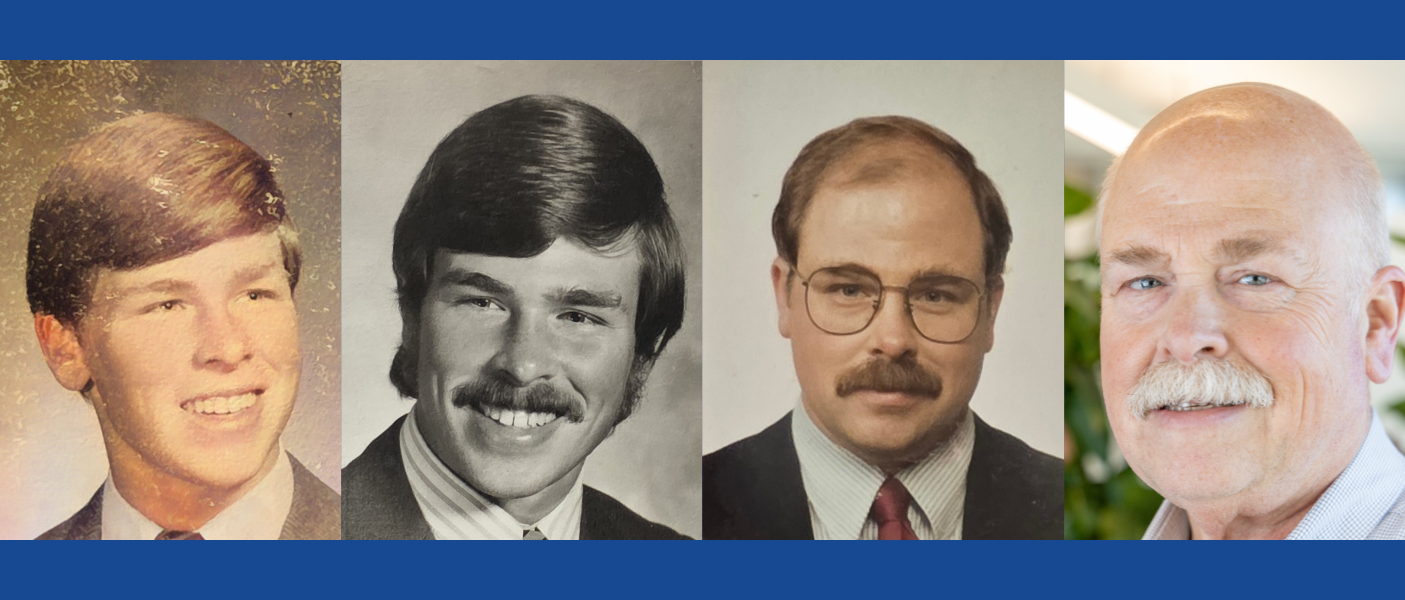
 Forty years ago, a bright young physician-scientist delivered an address to the American Society of Nephrology. To his surprise, the presentation sparked a “gold-rush fever” among department chairs trying to recruit him. Among them was Dr. Peter Ward, then Chair of Pathology, and the one who ultimately succeeded. In 1987, Paul Killen, MD, PhD, joined the Department of Pathology as an Assistant Professor.
At the time, Killen was a postdoctoral fellow at the NIH. He was considering positions at Brigham and Women’s Hospital in Boston and at the University of Michigan. “Marianne Tishma, Peter Ward’s secretary, picked me up at the hotel and was driving me to work down State Street early in the morning. There were three cars at the light, and she was complaining about the traffic. I was coming from Bethesda, where if you didn’t get on the freeway by 6:15 am, you wouldn’t get to work, 12 miles away, until 8:30 am, and then you would have to hunt for a parking place. It was a no-brainer. I had a family with two young children at the time, and Ann Arbor would enable me to spend more time with them instead of stuck in traffic.”
 When Killen was an undergrad, he got a job in a research lab with Dr. Belding Scribner, a famous nephrologist. “He had a can near the coffee where people would deposit money. That is how I was paid. Over the course of the summer, I think I made $300.” But this exposed Killen to biomedical sciences, and that was the beginning. He went on to medical school, earning an MD (1980) and a PhD in Pathology (1985) at the University of Washington in Seattle. “My research was in a very arcane area related to the extracellular matrices in the glomerulus.” He then went to the NIH for his postdoctoral fellowship, where he continued his studies. “I studied the genes that encoded those proteins and the transcriptional regulation of those genes.” When he came to Michigan, he continued his research on the extracellular matrix and collaborated with people like Jim Shayman, MD, Joel Weinberg, MD, and Roger Wiggins, MA, MB, BChir, from Nephrology.
 Once his research lab was well established, Killen added the responsibility of signing out renal cases. Killen became the director of the Medical Renal Service and the Electron Microscopy Laboratory. He recruited several junior faculty, many of whom are still here, including Jeffrey Hodgin, MD, PhD, who is now the director of the EM lab, Evan Farkash, MD, PhD, who is now the director of the Medical Renal Service, Cathryn Lapedis, MD, and Lois Arend, MD, PhD. “Cathryn Lapedis is perhaps our most junior member. She was in medical school and did a rotation with me. She was interested in going into rheumatology. I like to think that I swayed her to go into pathology.” Killen also knew Arend before she came to Michigan. “She was one of the postdoctoral fellows I supported. She completed her pathology residency and then did a pathology fellowship in renal pathology. There was no formal funding available for that from the graduate medical education program, so I paid her out of my grants. I did the same thing for Carrie Philips, who was our first fellow. She is now at Indiana.”
Killen’s research continued to progress, and he published on the structure of the regulatory regions and collagen 4 genes, looking at an osmotic response element in some genes that responded to osmotic stress. “It is all kind of esoteric work. There is some gene splicing that takes place and some of these stress response transcripts had never been described. But unfortunately, when we were at the point of proving the function of some of these alternate transcripts, my postdoctoral fellow decided to leave to study cancer research.”
 At about that time, Killen’s son, Jamie, suffered a traumatic brain injury. “This was one of the biggest challenges I experienced. He went from being a very active, vibrant 6th grader back to a 3rd-grade cognitive function. I could not continue the grind of trying to be a PI on an NIH R01 and focus on him.” Instead of continuing this research project, Killen took a step back and worked on collaborative projects with other investigators, focusing more on clinical work.
Looking back over his career, Killen found his greatest joy in reading biopsies and taking care of patients. He also loved teaching medical students. “In the past, medical students did not have this abbreviated basic science exposure. I taught first- and second- year students about kidney structure and function. We would have a small group of students and a team of instructors: an internist, a urologist, or a surgeon teamed with a pathologist. We would give students unknown cases and their histories, and they would hypothesize what was happening and what they expected to find in a kidney biopsy. It was close personal interactions. I really enjoyed this kind of teaching.”
 In addition to Jamie, Killen has one other son, who used to work in the Department of Pathology’s Pathology Informatics division, Robert Killen, and two daughters, Caitlin and Jenny. Killen met his wife when she was 15 years old in Washington. “We enjoyed sailing on Lake Washington and did a lot of aquatic stuff. She was a competitive alpine skier, and I was a ski bum.” After coming to Michigan, they realized it was a haul to get to the Great Lakes for sailing. “My oldest daughter wanted to learn how to ride. I mentioned this to one of the secretaries here. She offered to let her use her horse and to teach her. That horse was bomb proof. It had done everything from upper-level dressage, parades, and pony clubs. We later bought the horse.” Cricket then got the horse bug, so they bought another horse. “I couldn’t be the third wheel, so I had to get a horse for myself.” For the past 33 years, horses have been their life.
Killen will be retiring at the end of February 2026. As he looks to the future, he and Cricket are excited to build on their property. They own 45 acres on which they plan to build a horse barn, hay loft, and home. They are avid horse enthusiasts and enjoy three-day eventing, which includes dressage, cross country, and show jumping. While they once had five horses, they now have two retired horses (no longer ridden under saddle), and a third homebred Shire x Thoroughbred. The Killens travel to the Kentucky Horse Park each year to watch the premier eventing competition held in the United States, and Cricket continues to compete.
 One of Killen’s most meaningful memories, however, was completing a Century ride, where the ages of the horse and rider equal 100 or more. His horse was 28 years old and Killen was 72 years old when they made a gentle ride around the field, qualifying as a Century ride. Killen is planning a bit of a change once his property is built. “I dream of going to Iceland and purchasing an Icelandic Horse.” He explained that these horses have had a closed gene pool in Iceland for 1,000 years. For their first four years, they spend most of the year running free in the highlands, coming down to the lowlands for the winter. After four years, they begin training. “This results in horses who have learned respect from other horses, and they are very easy to train.”
We wish you great success on building your property and starting your Icelandic herd. Enjoy your retirement, Dr. Killen!
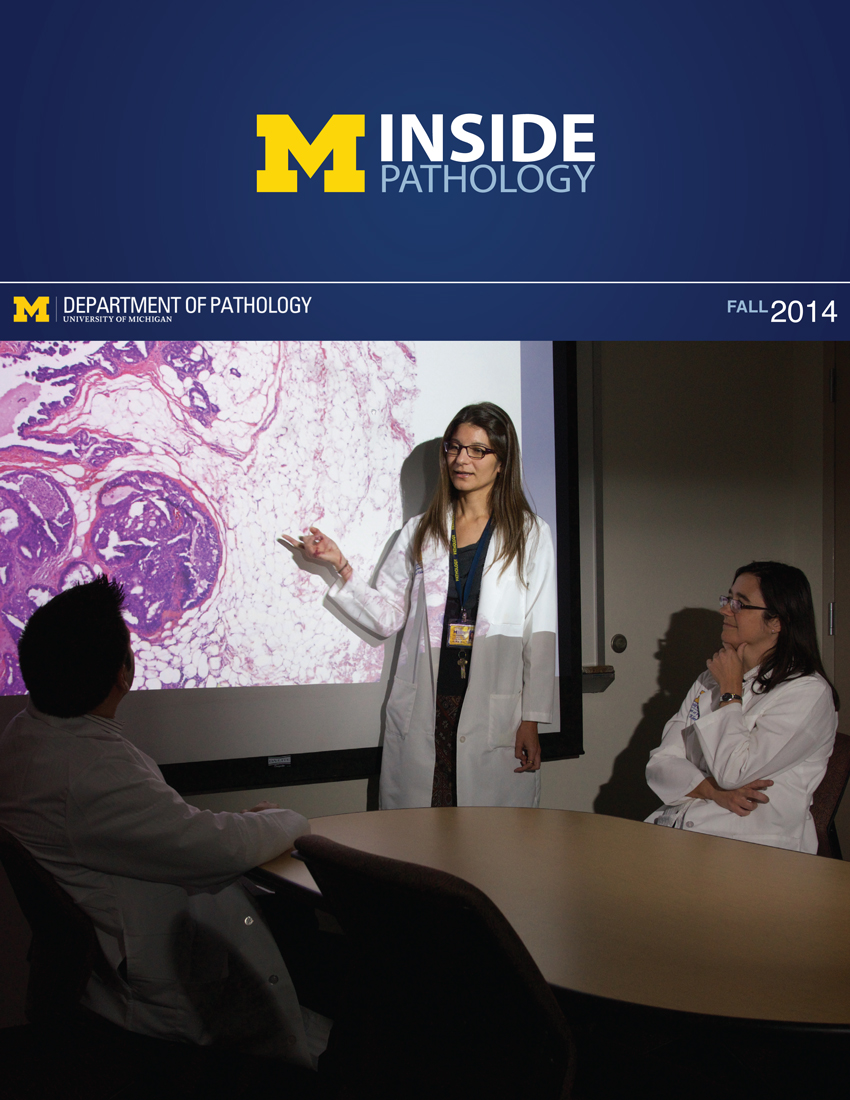 ON THE COVER
Breast team reviewing a patient's slide. (From left to right) Ghassan Allo, Fellow; Laura Walters, Clinical Lecturer; Celina Kleer, Professor. See Article |
newsletter
INSIDE PATHOLOGYAbout Our NewsletterInside Pathology is an newsletter published by the Chairman's Office to bring news and updates from inside the department's research and to become familiar with those leading it. It is our hope that those who read it will enjoy hearing about those new and familiar, and perhaps help in furthering our research. CONTENTS
|
 ON THE COVER
Autopsy Technician draws blood while working in the Wayne County morgue. See Article |
newsletter
INSIDE PATHOLOGYAbout Our NewsletterInside Pathology is an newsletter published by the Chairman's Office to bring news and updates from inside the department's research and to become familiar with those leading it. It is our hope that those who read it will enjoy hearing about those new and familiar, and perhaps help in furthering our research. CONTENTS
|
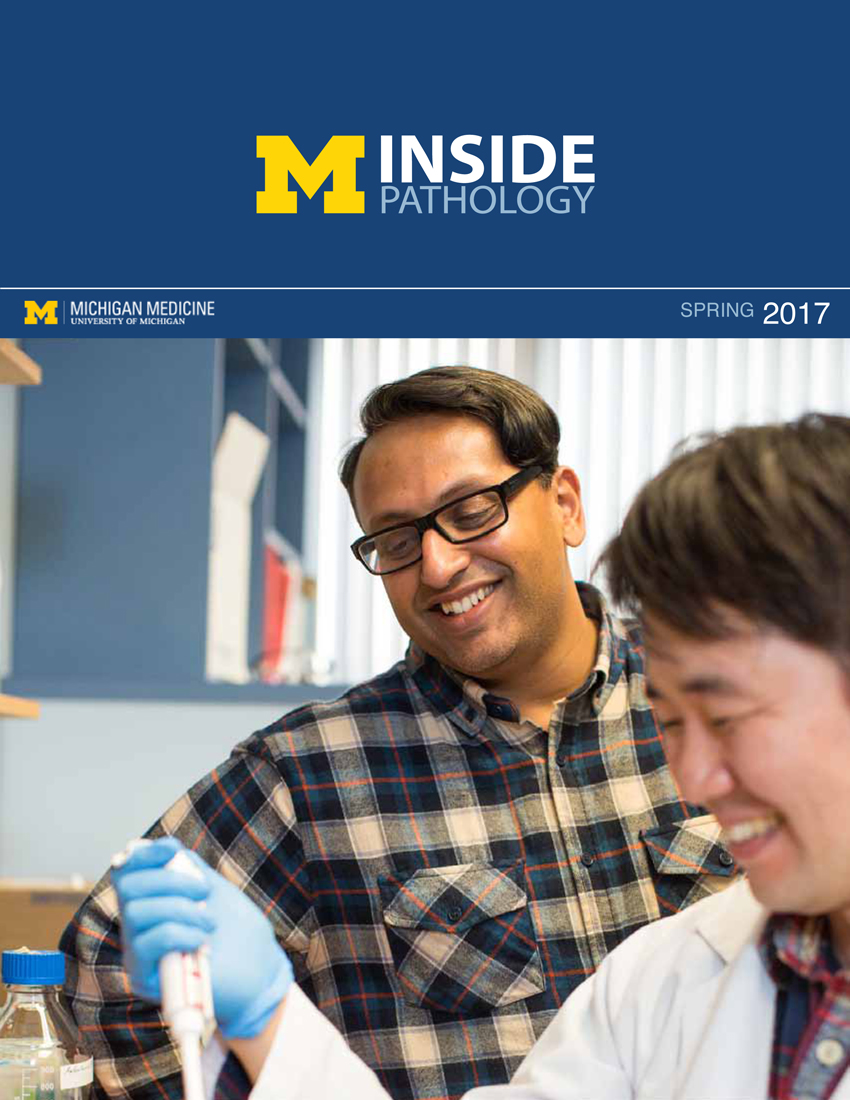 ON THE COVER
Dr. Sriram Venneti, MD, PhD and Postdoctoral Fellow, Chan Chung, PhD investigate pediatric brain cancer. See Article |
newsletter
INSIDE PATHOLOGYAbout Our NewsletterInside Pathology is an newsletter published by the Chairman's Office to bring news and updates from inside the department's research and to become familiar with those leading it. It is our hope that those who read it will enjoy hearing about those new and familiar, and perhaps help in furthering our research. CONTENTS
|
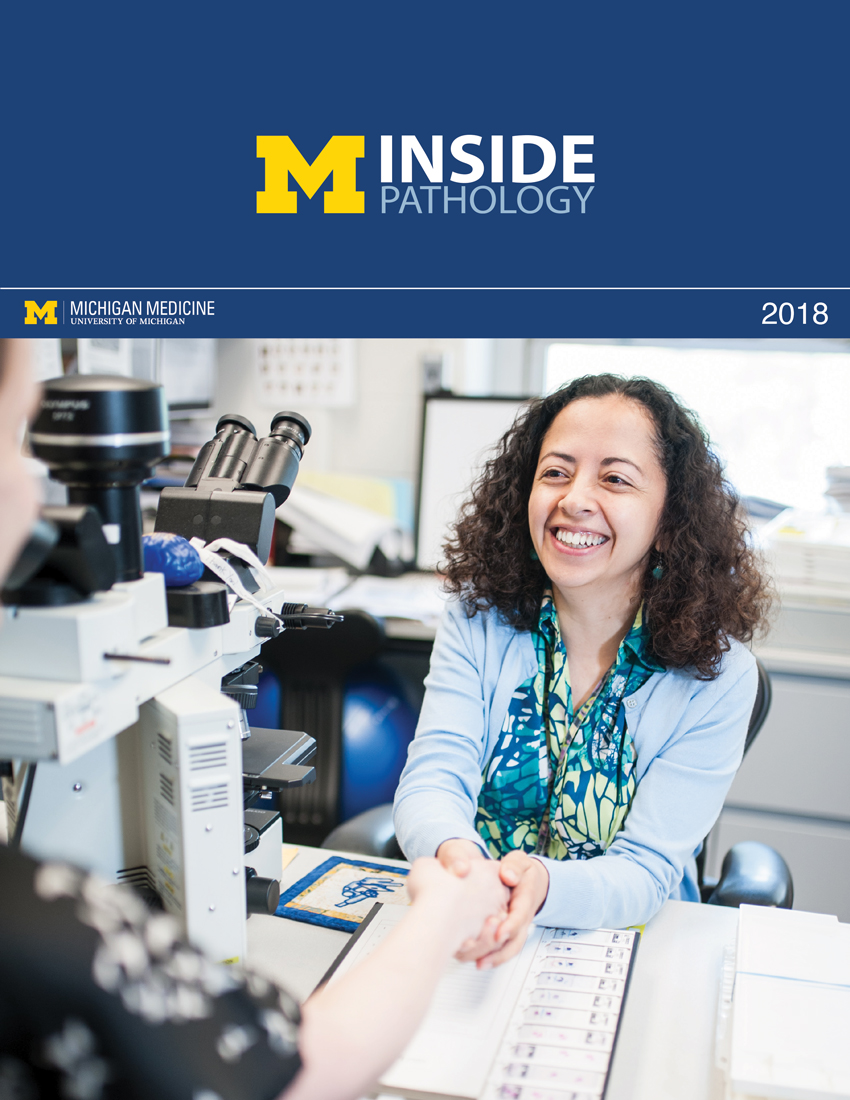 ON THE COVER
Director of the Neuropathology Fellowship, Dr. Sandra Camelo-Piragua serves on the Patient and Family Advisory Council. |
newsletter
INSIDE PATHOLOGYAbout Our NewsletterInside Pathology is an newsletter published by the Chairman's Office to bring news and updates from inside the department's research and to become familiar with those leading it. It is our hope that those who read it will enjoy hearing about those new and familiar, and perhaps help in furthering our research. CONTENTS
|
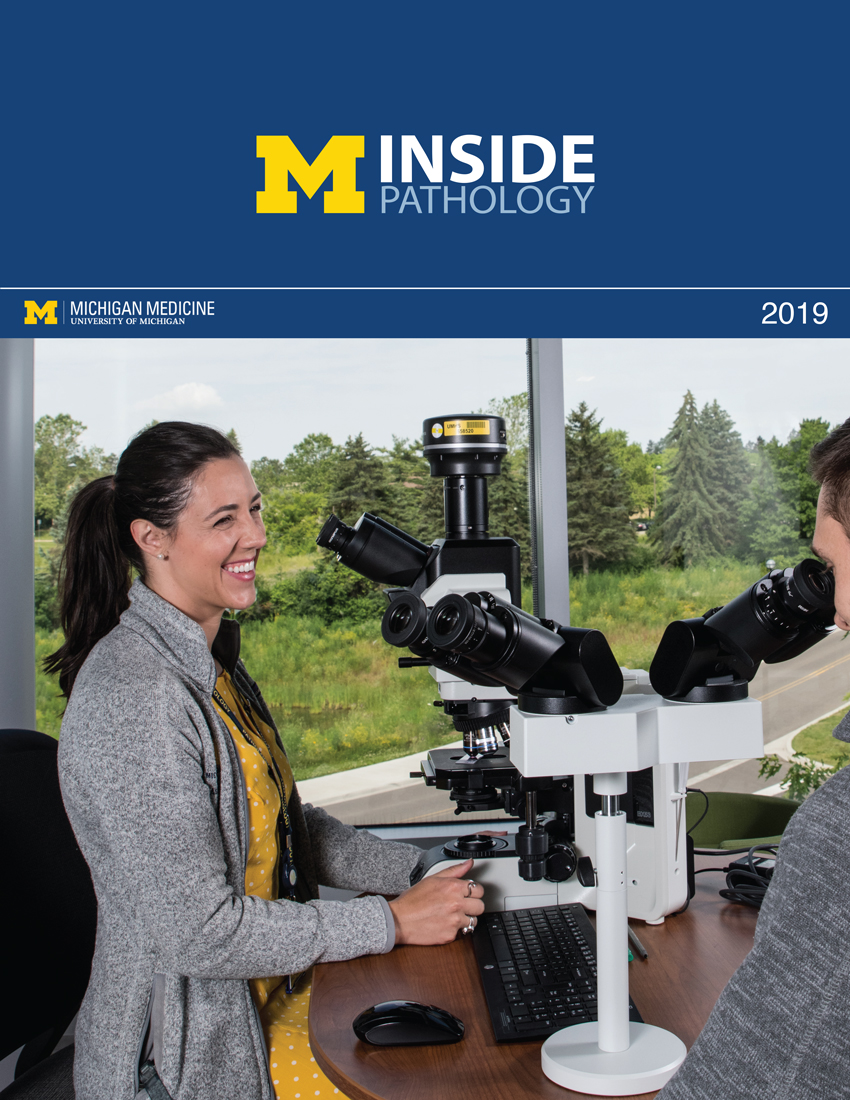 ON THE COVER
Residents Ashley Bradt (left) and William Perry work at a multi-headed scope in our new facility. |
newsletter
INSIDE PATHOLOGYAbout Our NewsletterInside Pathology is an newsletter published by the Chairman's Office to bring news and updates from inside the department's research and to become familiar with those leading it. It is our hope that those who read it will enjoy hearing about those new and familiar, and perhaps help in furthering our research. CONTENTS
|
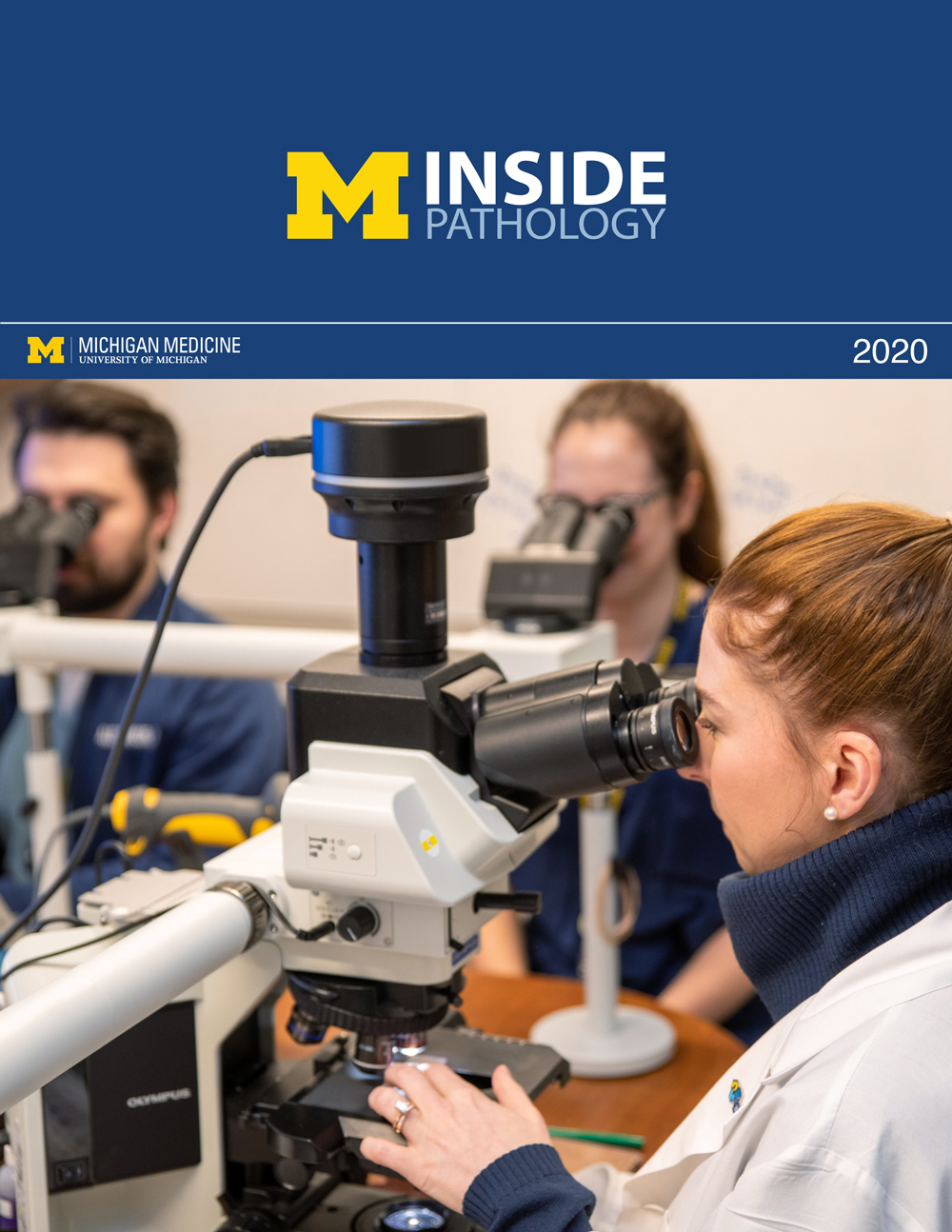 ON THE COVER
Dr. Kristine Konopka (right) instructing residents while using a multi-headed microscope. |
newsletter
INSIDE PATHOLOGYAbout Our NewsletterInside Pathology is an newsletter published by the Chairman's Office to bring news and updates from inside the department's research and to become familiar with those leading it. It is our hope that those who read it will enjoy hearing about those new and familiar, and perhaps help in furthering our research. CONTENTS
|
 ON THE COVER
Patient specimens poised for COVID-19 PCR testing. |
newsletter
INSIDE PATHOLOGYAbout Our NewsletterInside Pathology is an newsletter published by the Chairman's Office to bring news and updates from inside the department's research and to become familiar with those leading it. It is our hope that those who read it will enjoy hearing about those new and familiar, and perhaps help in furthering our research. CONTENTS
|
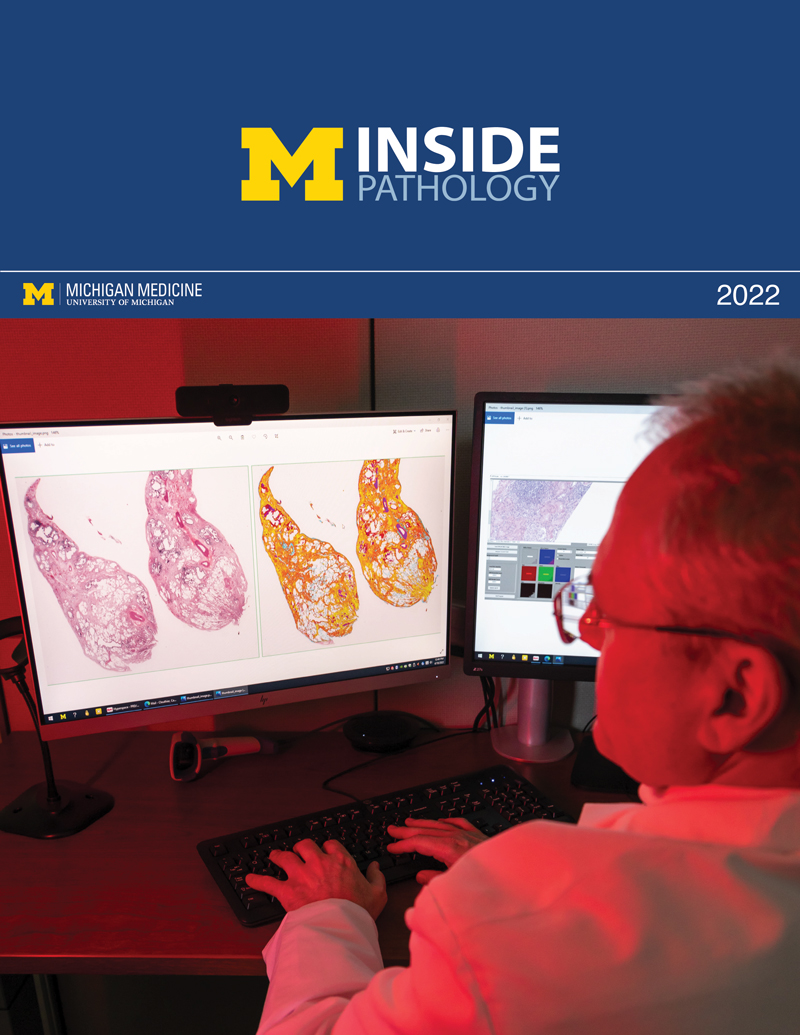 ON THE COVER
Dr. Pantanowitz demonstrates using machine learning in analyzing slides. |
newsletter
INSIDE PATHOLOGYAbout Our NewsletterInside Pathology is an newsletter published by the Chairman's Office to bring news and updates from inside the department's research and to become familiar with those leading it. It is our hope that those who read it will enjoy hearing about those new and familiar, and perhaps help in furthering our research. CONTENTS
|
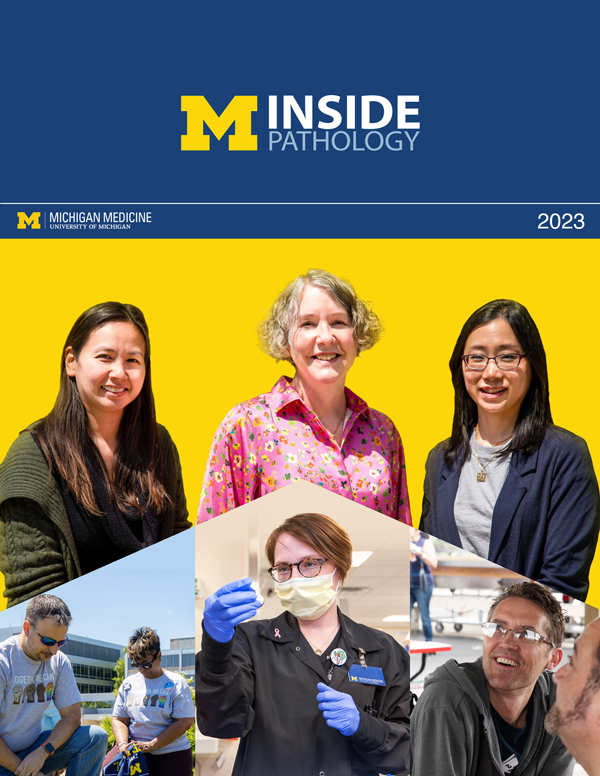 ON THE COVER
(Left to Right) Drs. Angela Wu, Laura Lamps, and Maria Westerhoff. |
newsletter
INSIDE PATHOLOGYAbout Our NewsletterInside Pathology is an newsletter published by the Chairman's Office to bring news and updates from inside the department's research and to become familiar with those leading it. It is our hope that those who read it will enjoy hearing about those new and familiar, and perhaps help in furthering our research. CONTENTS
|
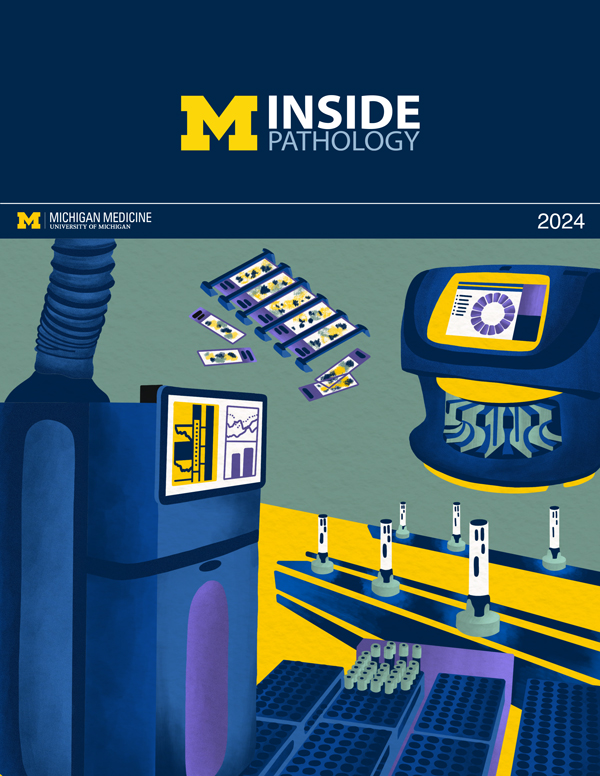 ON THE COVER
Illustration representing the various machines and processing used within our labs. |
newsletter
INSIDE PATHOLOGYAbout Our NewsletterInside Pathology is an newsletter published by the Chairman's Office to bring news and updates from inside the department's research and to become familiar with those leading it. It is our hope that those who read it will enjoy hearing about those new and familiar, and perhaps help in furthering our research. CONTENTS
|
 ON THE COVER
Rendering of the D. Dan and Betty Khn Health Care Pavilion. Credit: HOK |
newsletter
INSIDE PATHOLOGYAbout Our NewsletterInside Pathology is an newsletter published by the Chairman's Office to bring news and updates from inside the department's research and to become familiar with those leading it. It is our hope that those who read it will enjoy hearing about those new and familiar, and perhaps help in furthering our research. CONTENTS
|
MLabs, established in 1985, functions as a portal to provide pathologists, hospitals. and other reference laboratories access to the faculty, staff and laboratories of the University of Michigan Health System’s Department of Pathology. MLabs is a recognized leader for advanced molecular diagnostic testing, helpful consultants and exceptional customer service.