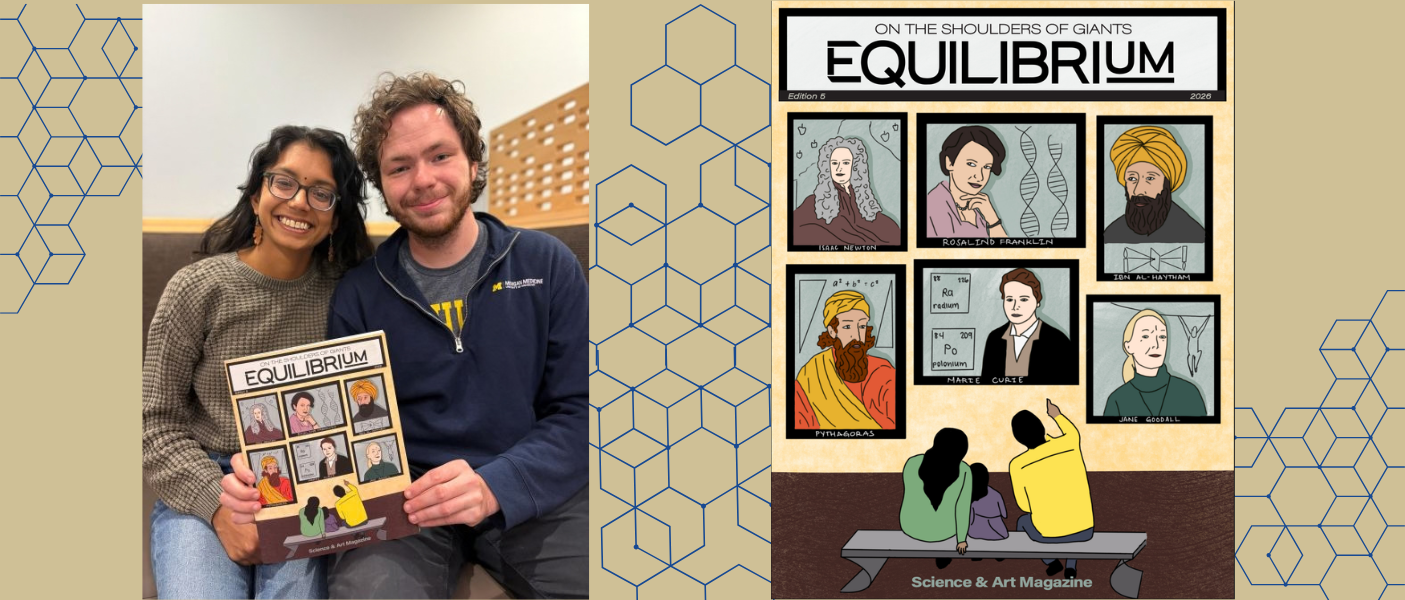
For graduate students immersed in highly specialized research, explaining complex scientific concepts to a general audience can be a challenge. A University of Michigan student organization is helping bridge that gap by giving students opportunities to write, illustrate, translate, and creatively communicate science in accessible, engaging ways.
 Formerly known as MiSciWriters (Michigan Science Writers), the organization recently rebranded as MiSciComm (Michigan Science Communicators) to reflect the broad range of science communication activities it now supports.
"We started as a graduate student organization focused on helping graduate students and postdoctoral fellows learn how to communicate science through writing," said Charukesi Dhurvas Sivakumar, a fifth-year doctoral student in the Molecular and Cellular Pathology (MCP) graduate program. "Over the years, we've expanded into illustrations, translation, outreach, and other forms of science communication. The new name better captures everything that we do."
Founded in 2015, the organization originally focused on blog-style scientific writing, pairing student writers with student editors to develop articles from initial concepts through publication. Today, MiSciComm serves graduate students from across the university, including those in biomedical sciences, engineering, physics, chemistry, and other disciplines in both writing and other aspects of science communication.
"We're really trying to reach students across the university," Sivakumar said. "Science communication is valuable regardless of your field."
A Creative Outlet for Scientists
One of the organization's signature projects is EquilibriUM, an annual print magazine that blends science, art, and storytelling. Now preparing to release its fifth edition, the publication showcases long-form science communication pieces alongside illustrations, photography, creative writing, and other artistic interpretations of scientific topics.
"It's different from our blog because we emphasize the intersection of science and art through longer-form content and a multimedia approach," Sivakumar said.
The magazine is distributed throughout campus buildings, medical campus locations, and businesses around Ann Arbor. Digital editions are also available through the organization's website.
For Colter Giem, a third-year MCP PhD student, discovering EquilibriUM introduced him to the organization.
"During my first few weeks at Michigan, I found one of the magazines sitting in a lounge area and started flipping through it," Giem said. "There was a poem about black holes, and I thought, 'This is really cool.'"
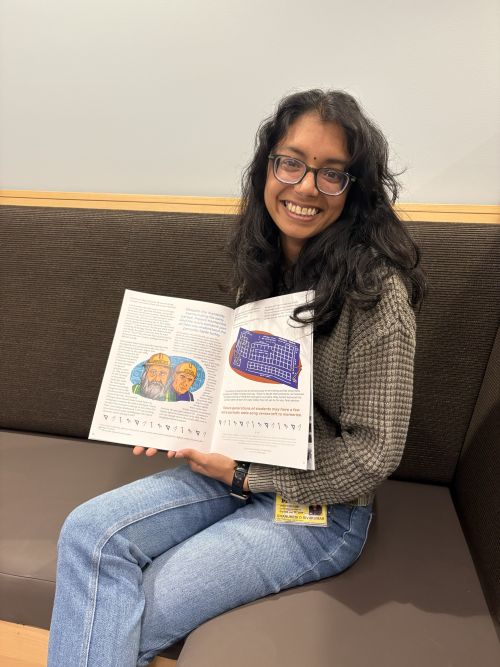
After reading the magazine, Giem visited the organization's website, learned more about its mission, and eventually joined as a writer. "I pitched a piece to EquilibriUM, worked with editors and an illustrator, and loved the process so much that I came back the next year as both an editor and illustrator," he said.
 Learning to Communicate Science Clearly
While graduate students receive extensive training in scientific writing and publishing, communication aimed at non-specialist audiences often receives less attention.
"As graduate students, we get a lot of opportunities to learn manuscript writing and publishing," Giem said. "What we don't always get is training in writing narratively and writing for general audiences."
That focus on accessibility is central to the organization's mission. "We're interested in how to communicate science to broader audiences and how to simplify complex scientific concepts and jargon," Sivakumar said. "Those skills are useful not just for science communication, but for teaching, presentations, outreach, and many other aspects of a scientific career."
For Giem, learning to communicate unfamiliar topics has also strengthened his own understanding of science. "When I wrote my article for EquilibriUM, it was about plant immunity, which was completely outside my area of expertise," he said. "Researching it and then explaining it to a lay audience helped me understand the subject at a much deeper level."
As Sivakumar noted, effective communication often tests understanding. "If you can explain it to someone else, then you really understand it."
Building Skills and Professional Networks
Beyond writing and publishing opportunities, MiSciComm provides members with valuable networking experiences. Sivakumar has been involved with the organization for four years, first serving as communications director and now as scientific engagement and outreach coordinator. Through that work, she has helped organize workshops, recruit guest speakers, maintain the organization's website and blog, and develop programming focused on visual communication and design.
Recent offerings have included graphic design workshops and collaborations with other student organizations, reflecting a growing emphasis on the many forms that science communication can take.
The group is also actively involved with ComSciCon-Michigan, part of a nationally recognized science communication initiative that brings together graduate students from universities across the state, including the University of Michigan, Michigan State University, and Wayne State University.
Through these activities, members connect with professionals working in science communication, outreach, education, publishing, and related careers. "The networking opportunities have been incredible," Sivakumar said. "It's helped me realize that science communication is something I genuinely enjoy and something I want to pursue as part of my future career."
 An Open Invitation
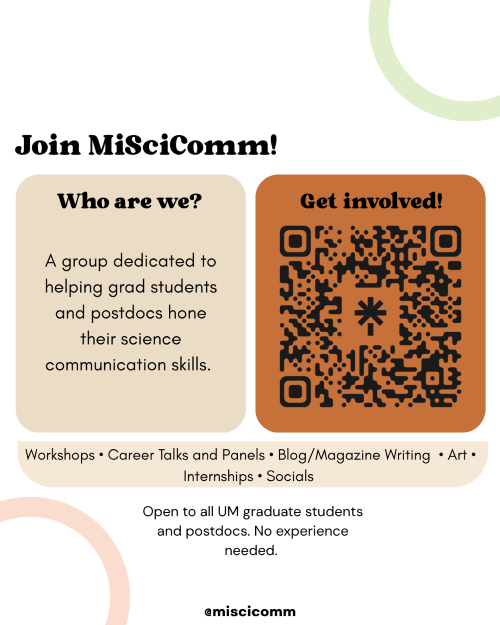
Members say one of the organization's strengths is its accessibility. "MiSciComm is a very low-pressure and welcoming environment," Sivakumar said. "You can contribute as a writer, editor, illustrator, and translator. You don't need prior experience, and you can explore areas you've always been curious about."
The organization welcomes graduate students from all disciplines and is always looking for new contributors. "We're always looking for more people to get involved," Sivakumar said. "Whether you want to write, edit, illustrate, or simply learn more about science communication, there's a place for you."
Those interested can learn more through the MiSciComm website, where information about meetings, workshops, publication opportunities, and membership is regularly posted.
Read stories written by our MCP graduate students:
Charu Sivakumar - From Synapses to Symphonies: A Connection Through Sounds
Colter Giem - Fighting in the Fields: Plant Immunity, Crop Diseases and the Battle to Feed the World
 ON THE COVER
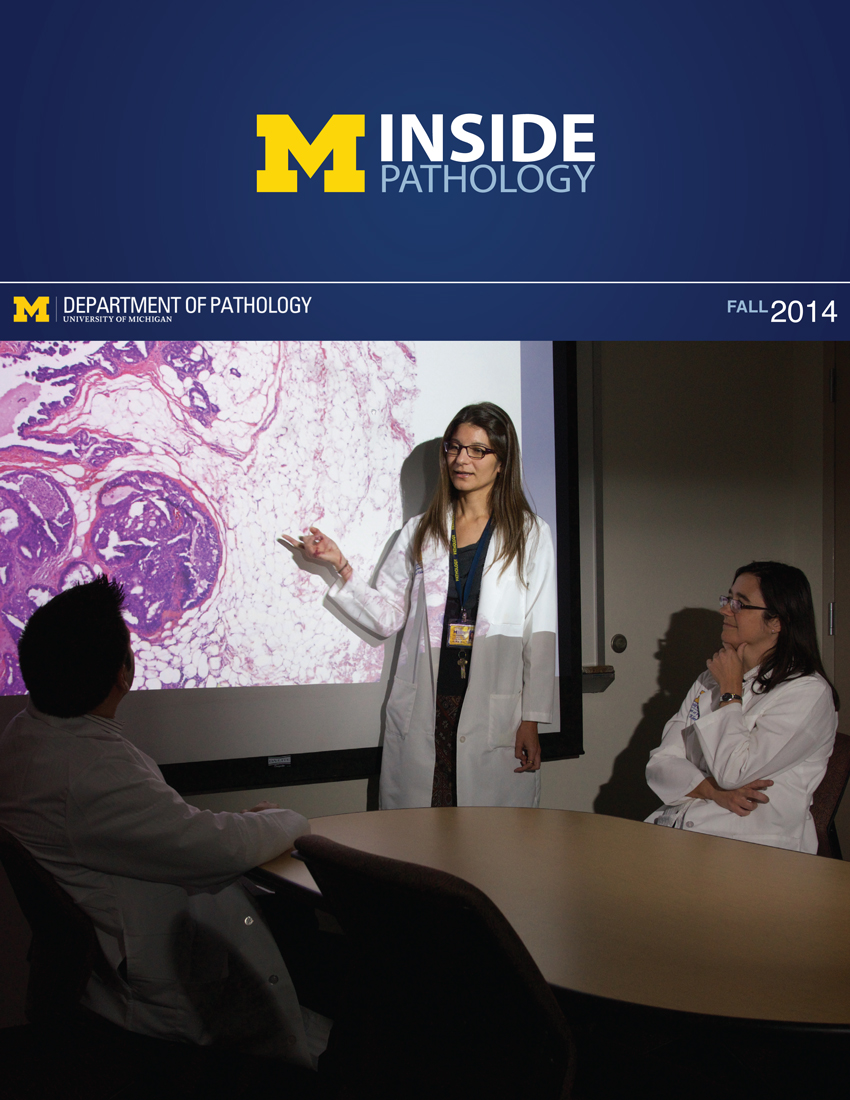
Breast team reviewing a patient's slide. (From left to right) Ghassan Allo, Fellow; Laura Walters, Clinical Lecturer; Celina Kleer, Professor. See Article |
newsletter
INSIDE PATHOLOGYAbout Our NewsletterInside Pathology is an newsletter published by the Chairman's Office to bring news and updates from inside the department's research and to become familiar with those leading it. It is our hope that those who read it will enjoy hearing about those new and familiar, and perhaps help in furthering our research. CONTENTS
|
 ON THE COVER
Autopsy Technician draws blood while working in the Wayne County morgue. See Article |
newsletter
INSIDE PATHOLOGYAbout Our NewsletterInside Pathology is an newsletter published by the Chairman's Office to bring news and updates from inside the department's research and to become familiar with those leading it. It is our hope that those who read it will enjoy hearing about those new and familiar, and perhaps help in furthering our research. CONTENTS
|
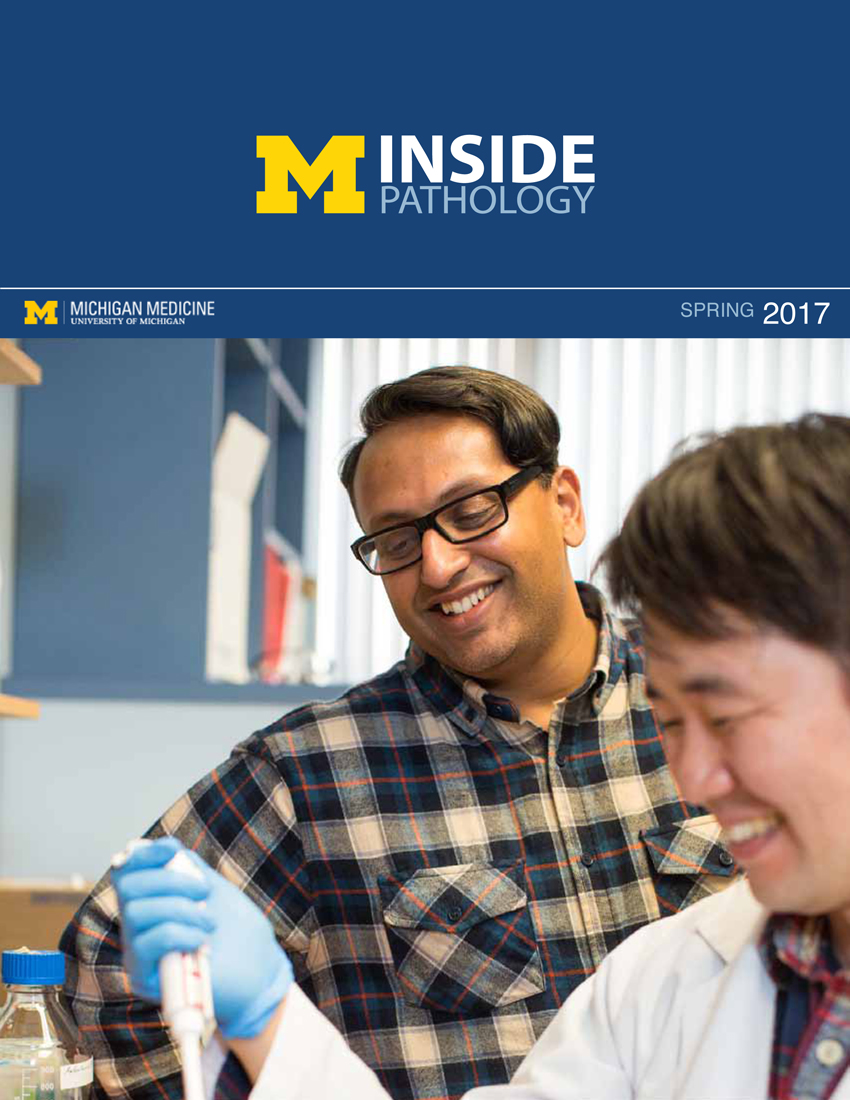 ON THE COVER
Dr. Sriram Venneti, MD, PhD and Postdoctoral Fellow, Chan Chung, PhD investigate pediatric brain cancer. See Article |
newsletter
INSIDE PATHOLOGYAbout Our NewsletterInside Pathology is an newsletter published by the Chairman's Office to bring news and updates from inside the department's research and to become familiar with those leading it. It is our hope that those who read it will enjoy hearing about those new and familiar, and perhaps help in furthering our research. CONTENTS
|
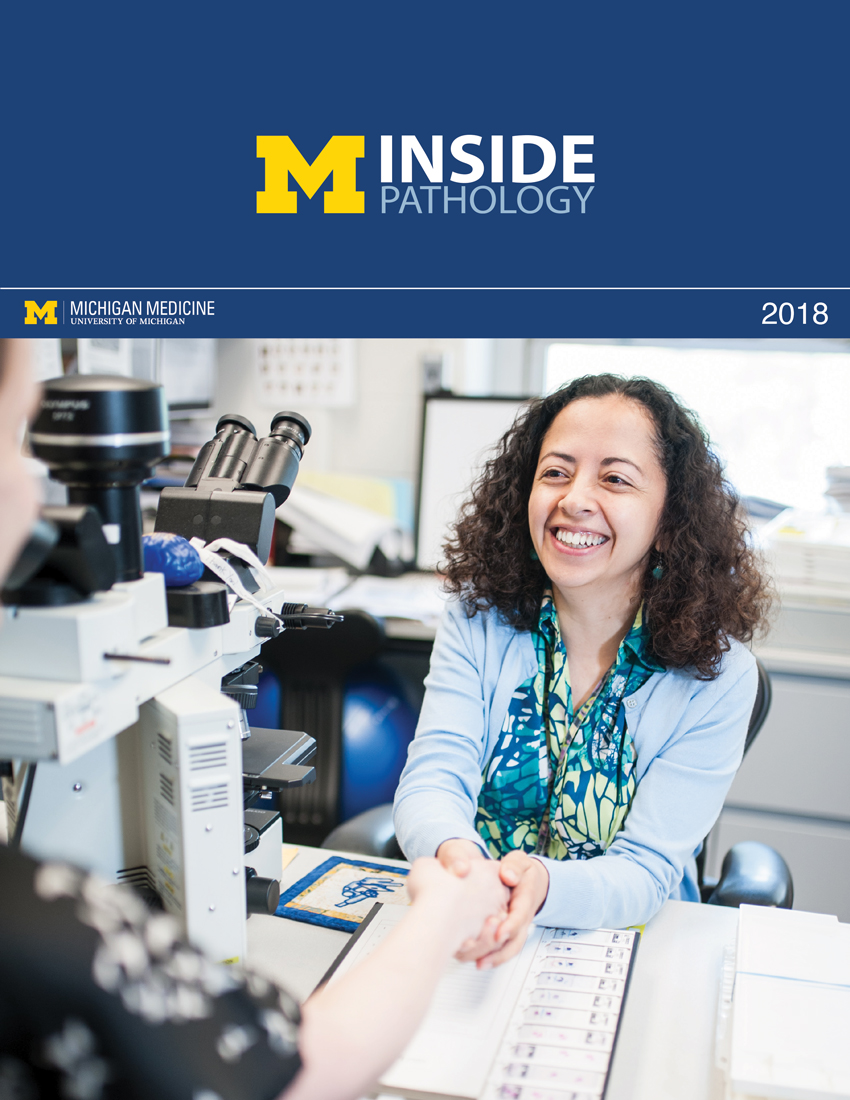 ON THE COVER
Director of the Neuropathology Fellowship, Dr. Sandra Camelo-Piragua serves on the Patient and Family Advisory Council. |
newsletter
INSIDE PATHOLOGYAbout Our NewsletterInside Pathology is an newsletter published by the Chairman's Office to bring news and updates from inside the department's research and to become familiar with those leading it. It is our hope that those who read it will enjoy hearing about those new and familiar, and perhaps help in furthering our research. CONTENTS
|
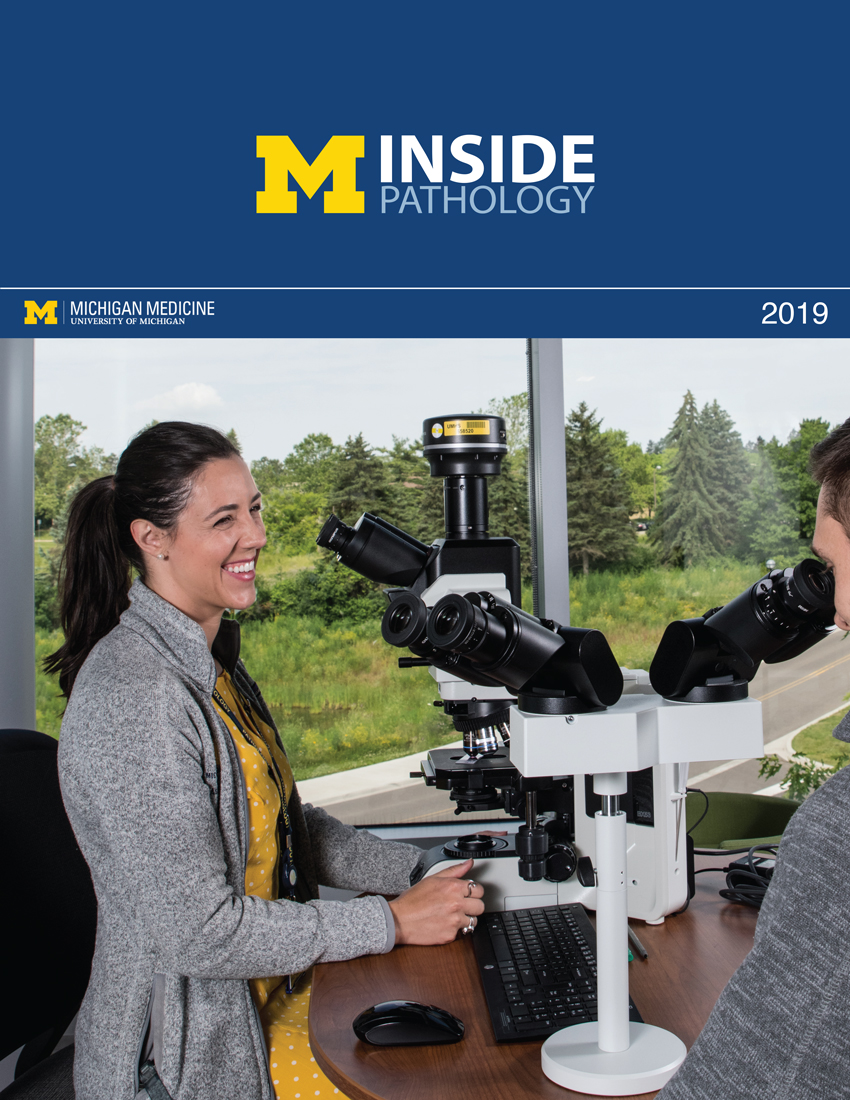 ON THE COVER
Residents Ashley Bradt (left) and William Perry work at a multi-headed scope in our new facility. |
newsletter
INSIDE PATHOLOGYAbout Our NewsletterInside Pathology is an newsletter published by the Chairman's Office to bring news and updates from inside the department's research and to become familiar with those leading it. It is our hope that those who read it will enjoy hearing about those new and familiar, and perhaps help in furthering our research. CONTENTS
|
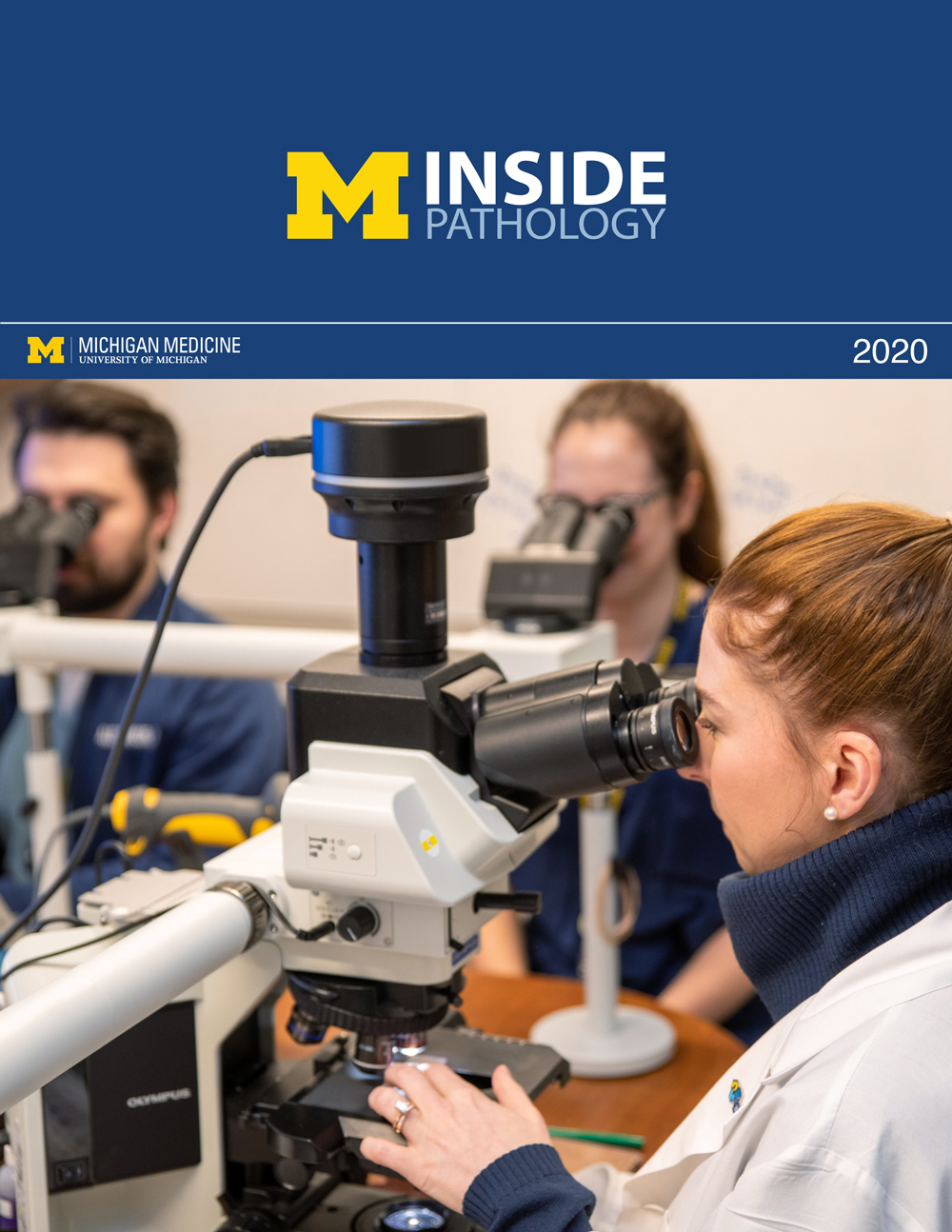 ON THE COVER
Dr. Kristine Konopka (right) instructing residents while using a multi-headed microscope. |
newsletter
INSIDE PATHOLOGYAbout Our NewsletterInside Pathology is an newsletter published by the Chairman's Office to bring news and updates from inside the department's research and to become familiar with those leading it. It is our hope that those who read it will enjoy hearing about those new and familiar, and perhaps help in furthering our research. CONTENTS
|
 ON THE COVER
Patient specimens poised for COVID-19 PCR testing. |
newsletter
INSIDE PATHOLOGYAbout Our NewsletterInside Pathology is an newsletter published by the Chairman's Office to bring news and updates from inside the department's research and to become familiar with those leading it. It is our hope that those who read it will enjoy hearing about those new and familiar, and perhaps help in furthering our research. CONTENTS
|
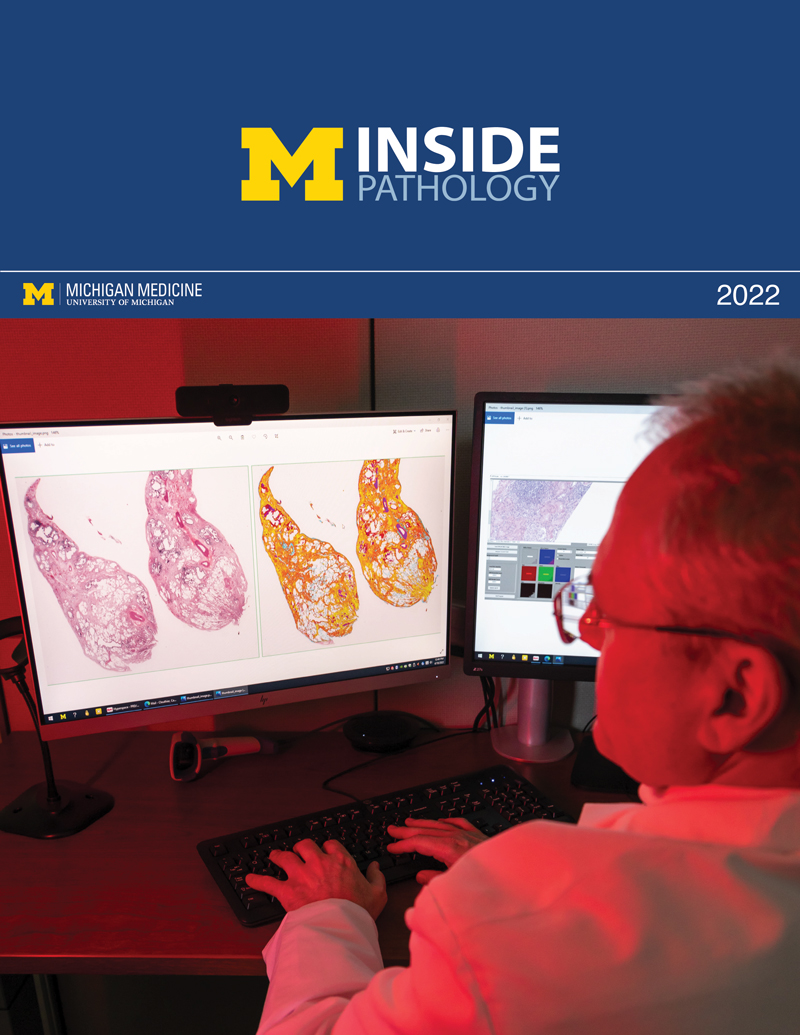 ON THE COVER
Dr. Pantanowitz demonstrates using machine learning in analyzing slides. |
newsletter
INSIDE PATHOLOGYAbout Our NewsletterInside Pathology is an newsletter published by the Chairman's Office to bring news and updates from inside the department's research and to become familiar with those leading it. It is our hope that those who read it will enjoy hearing about those new and familiar, and perhaps help in furthering our research. CONTENTS
|
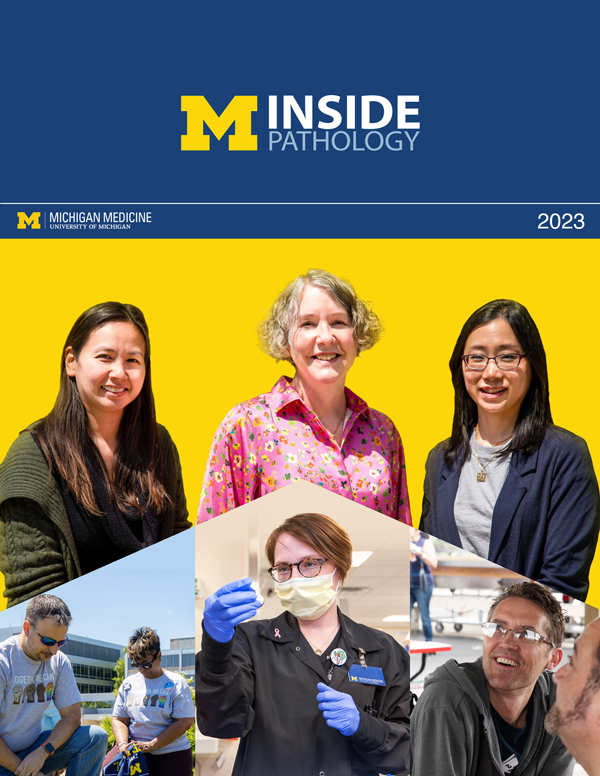 ON THE COVER
(Left to Right) Drs. Angela Wu, Laura Lamps, and Maria Westerhoff. |
newsletter
INSIDE PATHOLOGYAbout Our NewsletterInside Pathology is an newsletter published by the Chairman's Office to bring news and updates from inside the department's research and to become familiar with those leading it. It is our hope that those who read it will enjoy hearing about those new and familiar, and perhaps help in furthering our research. CONTENTS
|
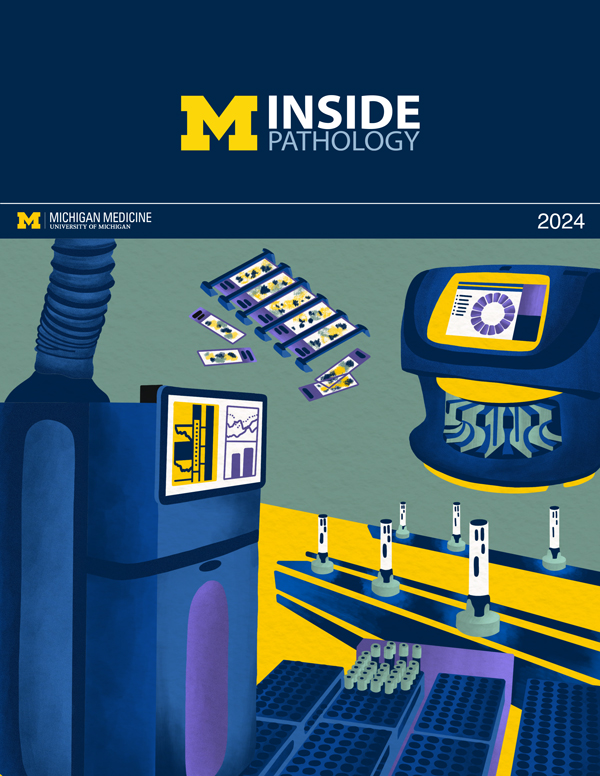 ON THE COVER
Illustration representing the various machines and processing used within our labs. |
newsletter
INSIDE PATHOLOGYAbout Our NewsletterInside Pathology is an newsletter published by the Chairman's Office to bring news and updates from inside the department's research and to become familiar with those leading it. It is our hope that those who read it will enjoy hearing about those new and familiar, and perhaps help in furthering our research. CONTENTS
|
 ON THE COVER
Rendering of the D. Dan and Betty Khn Health Care Pavilion. Credit: HOK |
newsletter
INSIDE PATHOLOGYAbout Our NewsletterInside Pathology is an newsletter published by the Chairman's Office to bring news and updates from inside the department's research and to become familiar with those leading it. It is our hope that those who read it will enjoy hearing about those new and familiar, and perhaps help in furthering our research. CONTENTS
|

MLabs, established in 1985, functions as a portal to provide pathologists, hospitals. and other reference laboratories access to the faculty, staff and laboratories of the University of Michigan Health System’s Department of Pathology. MLabs is a recognized leader for advanced molecular diagnostic testing, helpful consultants and exceptional customer service.