Nature study reveals a new weakness in aggressive pediatric brain tumors
By Lynn McCain | September 21 A team of researchers from the University of Michigan Department of Pathology has identified a previously unknown vulnerability in one of the most aggressive forms of pediatric brain cancer, opening the door to potential new treatment strategies for children with limited therapeutic options. The research, published in Nature, was led by first author Siva Kumar Natarajan, PhD, a research investigator in the laboratory of Sriram Venneti, MD, PhD., with significant contributions by Joanna Lum, a Molecular and Cellular Pathology graduate student.
The study focused on ZFTA-RELA ependymoma, a malignant brain tumor that most commonly affects children. Unlike many cancers that arise from numerous genetic mutations, these tumors are driven almost entirely by a single fusion oncogene created when two genes, ZFTA and RELA, become abnormally joined together. Researchers have long known that this fusion drives tumor formation, but exactly how it sustains tumor growth remained unclear.
"We wanted to understand how this fusion oncogene changes metabolism in tumor cells," said Natarajan. "Cancer cells often rewire their metabolism to support growth, and we suspected this oncogene might be doing something similar."
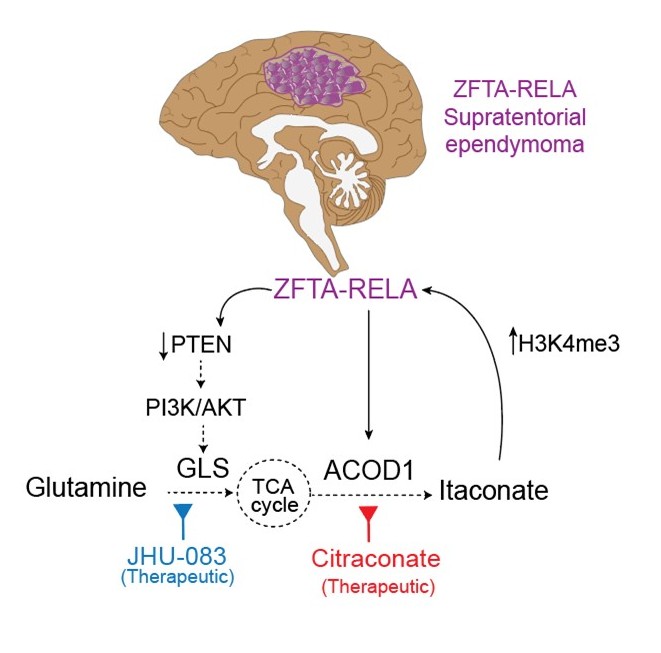 Using patient-derived cell lines, mouse models, and patient-derived xenografts, the team discovered that ZFTA-RELA ependymomas produce unusually large amounts of itaconate, a metabolite typically associated with immune cells rather than cancer cells. The finding was unexpected because itaconate has historically been studied primarily in macrophages and other immune cells involved in inflammation.
"What was surprising was seeing an immune-associated metabolite become one of the most abundant metabolites in these tumor cells," Natarajan said. "Our first question was: Why are these tumors making so much of it?"
The answer revealed a previously unknown biological feedback loop. The researchers found that the tumor cells rely on an enzyme called ACOD1 to produce itaconate. Rather than being a byproduct of cancer growth, itaconate actively helps sustain the tumor-driving fusion gene itself. The metabolite alters the tumor's epigenetic landscape, keeping the fusion oncogene switched on and allowing the cancer to continue growing.
In effect, the cancer creates a self-reinforcing cycle: the fusion oncogene increases ACOD1 activity, ACOD1 produces itaconate, and itaconate helps maintain expression of the fusion oncogene. Disrupting any part of that loop reduced tumor growth. When the researchers blocked ACOD1 genetically or pharmacologically, tumor cells became significantly less viable, and animals lived substantially longer. In some experimental models, more than half of animals lacking ACOD1 never developed tumors at all.
The team also discovered that ZFTA-RELA ependymomas have an unusual dependence on glutamine, an amino acid that serves as the primary carbon source for producing itaconate. Targeting glutamine metabolism reduced itaconate levels, decreased expression of the tumor-driving fusion oncogene, and dramatically extended survival in preclinical models. Importantly, several of the pathways identified in the study can already be targeted with drugs tested in other pediatric cancers.
"One of the exciting aspects of this work is its translational potential," Natarajan said. "There are currently no targeted therapies for these tumors. However, some of the pathways we identified can be inhibited with drugs that already have pediatric safety data, which may accelerate efforts to bring new treatments to patients."
The researchers are now working with the Pediatric Neuro-Oncology Consortium to evaluate potential therapeutic approaches and generate the preclinical data needed to support future clinical trials.
Beyond ependymoma, the findings may have broader implications for other cancers driven by fusion oncogenes. "Many fusion-driven cancers are defined by a single dominant genetic event," Natarajan said. "Our study suggests there may be ways to target the mechanisms that sustain those oncogenes after they form. If that's true, this approach could potentially apply to a much broader group of cancers."
The study has already generated significant interest from collaborators worldwide, including researchers studying itaconate biology and pediatric brain tumors. The team has filed a provisional patent related to the discovery and continues to investigate how the findings can be translated into future therapies for children with these devastating tumors.
The research was supported by multiple funding organizations, including an AACR-SONTAG Foundation Brain Cancer Research Fellowship and an Alex's Lemonade Stand Foundation Young Investigator Award, supporting Natarajan's work.
****
Citation:
Natarajan, S.K., Lum, J., Skeans, J.H. et al. ZFTA–RELA ependymomas make itaconate to epigenetically drive fusion expression. Nature (2026) 652:1004–1015. https://doi.org/10.1038/s41586-025-10005-1
 ON THE COVER
 ON THE COVER
 ON THE COVER
 ON THE COVER
 ON THE COVER
 ON THE COVER
 ON THE COVER
 ON THE COVER
 ON THE COVER
 ON THE COVER
 ON THE COVER